On 28 September 2023, Daniel M. Greenberger was awarded an IQOQI Fellowship for his groundbreaking contributions to the foundations of Quantum Physics. He led the work on the Greenberger-Horne-Zeilinger theorem opening the field of multiparticle entanglement. On the interplay between gravity and quantum physics he made crucial investigations in neutron and atom interferometry and proposed a novel role of proper mass and proper time as dynamical variables.
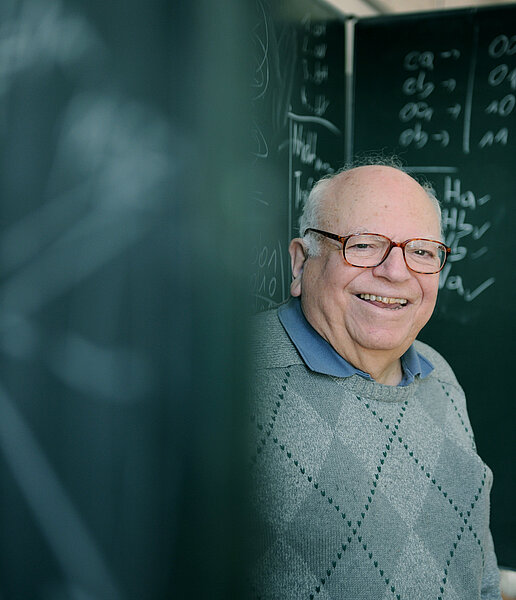
Daniel M. Greenberger is one of the most original and unconventional thinkers in modern physics. He set out to explore the nature of the world via his study of physics at MIT with Nobel laureate Cliff Shull. There, he received his B.S. in 1954, and later completed graduate work through the University of Illinois, earning his M.S. in 1956 and Ph.D. in 1958. Soon, he began his long and distinguished career as professor of physics at the City College of New York (CCNY) which continues until this day.
Daniel Greenberger's unique path occasionally led him down fascinating and somewhat unconventional byways. Trained originally as a high-energy theorist, he moved into gravity, neutron interferometry, and soon was drawn into some of the deepest conceptual questions in quantum mechanics. His lines of thought, which he follows right to their very end, occasionally lead him to radical consequences and implications for how we see the world.
Scientific achievements
Daniel Greenberger made lasting contributions to the foundations of quantum physics, especially in the study of entanglement, nonlocality, and the conceptual structure of quantum theory.
Danny is of the creators of the Greenberger-Horne-Zeilinger (GHZ) theorem, developed together with Michael Horne and Anton Zeilinger in the late 1980s. This work showed a profound contradiction between classical ideas of local realism and the predictions of quantum mechanics, going beyond Bell’s theorem with a sharper and more direct formalism, opening up the field of multi-particle interference. GHZ states have since become central to quantum information science and the modern understanding of quantum correlations.
Long before GHZ, Greenberger had already made important contributions to neutron interferometry, particularly in work on gravity and matter waves. He was deeply interested in the relationship between quantum mechanics and relativity, and over the course of many years he developed striking ideas about mass and proper time as dynamical variables, challenging standard assumptions in both classical and quantum theory.
Daniel Greenberger and IQOQI-Vienna
A defining aspect of Daniel Greenberger’s scientific life was his long friendship and collaboration with Anton Zeilinger, which started in 1978, when Greenberger, Zeilinger, Michael Horne, and others met through work in neutron interferometry. What began there developed into one of the most fruitful and influential collaborations in the foundations of quantum physics.
In 1986, Greenberger visited Vienna on a Fulbright grant, and it was there that the ideas leading to the GHZ theorem took shape. In an interview for Der Standard, Zeilinger said that GHZ was one of the reasons he shifted from neutrons to photons, a path that ultimately contributed to the research that led to his Nobel prize.
Greenberger has been closely connected to Vienna in the decades since then, returning often and becoming a familiar and beloved presence in the intellectual life surrounding the IQOQI-Vienna and the Vienna quantum community. More than a collaborator, Danny Greenberger remains a constant source of challenge, conversation, and inspiration.