


Caslav Brukner
- Scientific & Deputy Executive Director
- Group Leader
- +43 (1) 4277 - 72582
- Caslav.Brukner(at)oeaw.ac.at
Quantum and classical physics differ not only mathematically, but also conceptually. Understanding how classical behaviour emerges from quantum theory remains one of the central open questions in physics.
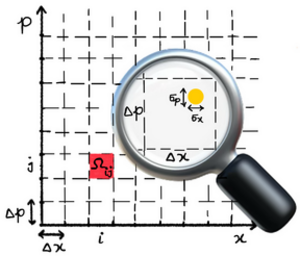
Our group developed an approach to this problem that is conceptually distinct from decoherence and instead emphasises the limited precision with which quantum effects can be observed. We showed that, under sufficiently coarse-grained measurements, quantum features become inaccessible and quantum states appear effectively classical, admitting an effective joint probability distribution for all coarse-grained observables. This gives rise to macroscopic realism. If, in addition, the dynamics is probed frequently enough through coarse-grained observables, then both macroscopic realism and effective Newtonian laws emerge from standard quantum theory. In separate work, we also introduced no-signalling in time as a necessary condition for violations of macroscopic realism, analogous to the role of no-signalling in Bell scenarios.
J. Kofler and Č. Brukner, Classical world arising out of quantum physics under the restriction of coarse-grained measurements, Phys. Rev. Lett. 99, 180403 (2007)
J. Kofler and Č. Brukner, Conditions for quantum violation of macroscopic realism, Phys. Rev. Lett. 101 090403 (2008)
Č. Brukner, In the "Kreisgang" between classical and quantum physics, UniMolti modi della filosofia 2008/2 (in Italian), (e-print) (in English)
J. Kofler and C. Brukner, Condition for macroscopic realism beyond the Leggett-Garg inequalities, Phys. Rev. A 87, 052115 (2013).
F. Bibak, C. Cepollaro, N. M. Sánchez, B. Dakić, and Č. Brukner, The classical limit of quantum mechanics through coarse-grained measurements, arXiv:2503.15642 (2025).