


Caslav Brukner
- Stellv. Institutsdirektor
- Gruppenleiter
- +43 (1) 4277 - 72582
- Caslav.Brukner(at)oeaw.ac.at
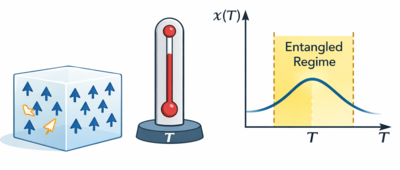
It is often assumed that entanglement plays no relevant role in large macroscopic systems at moderately high temperatures, because decoherence suppresses quantum correlations. Our group showed that this view is too limited: entanglement can be crucial for the correct description of macroscopic properties of solids.
We found that thermodynamic quantities such as internal energy, heat capacity, and magnetic susceptibility can act as entanglement witnesses, detecting entanglement in solids even in the thermodynamic limit and at moderately high temperatures. We also identified critical temperature and magnetic-field regimes below which entanglement must exist. In this way, our work showed that entanglement can remain physically relevant far beyond the microscopic domain.
Č. Brukner and V. Vedral, Macroscopic Thermodynamical Witnesses of Quantum Entanglement
M. Wiesniak. V. Vedral & Č. Brukner, Magnetic Susceptibility as Macroscopic Entanglement Witness, New J. Phys. 7, 258 (2005)
Č. Brukner, V. Vedral and A. Zeilinger, Crucial Role of Quantum Entanglement in Bulk Properties of Solids, Phys. Rev. A 73, 012110 (2006)
J. Kofler and Č. Brukner, Entanglement Distribution Revealed by Macroscopic Observations, Phys. Rev. A 74, 050304(R) (2006)
M. Wiesniak, V. Vedral, and Č. Brukner, Heat capacity as an indicator of entanglement, Phys. Rev. B 78, 064108 (2008)