


Caslav Brukner
- Stellv. Institutsdirektor
- Gruppenleiter
- +43 (1) 4277 - 72582
- Caslav.Brukner(at)oeaw.ac.at
Entanglement cannot be used for direct communication, but it can nonetheless reduce the amount of classical communication required for distant parties to perform a joint task. This is the setting of communication complexity, where the goal is to compute a function whose inputs are distributed among remote parties while exchanging as little information as possible.
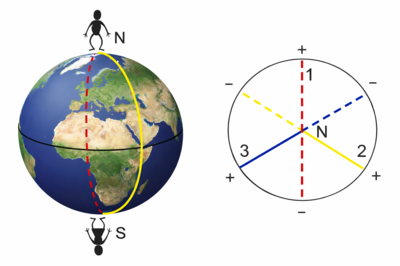
Our group showed that the usefulness of entanglement in such protocols is closely tied to its Bell nonlocality: for every Bell inequality, there exists a communication-complexity problem for which states violating the inequality enable better performance than any classical protocol. We developed such protocols for qubits, qutrits, and higher-dimensional systems, and also analysed striking examples in which entanglement helps separated parties coordinate even without communication. We also showed that a quantum superposition of communication directions can itself serve as a resource, yielding exponential advantages over one-way classical and quantum communication in suitable tasks.
Č. Brukner, M. Zukowski, and A. Zeilinger, Quantum communication complexity protocol with two entangled qutrits,Phys. Rev. Lett. 89, 197901 (2002)
Č. Brukner, M. Zukowski, J.-W. Pan and A. Zeilinger, Bell's inequality and Quantum Communication Complexity, Phys. Rev. Lett. 92, 127901 (2004
Č. Brukner, N. Paunkovic, T. Rudolph and V. Vedral, Entanglement-assisted Orientation in Space, Int. J. of Quant. Inf. 4, (2006) 365
P. A. Guérin, A. Feix, M. Araújo and Č. Brukner, Exponential Communication Complexity Advantage from Quantum Superposition of the Direction of Communication, Phys. Rev. Lett. 117, 100502 (2016)