



Macrorealism as strict classicality in the framework of generalized probabilistic theories (and how to falsify it)
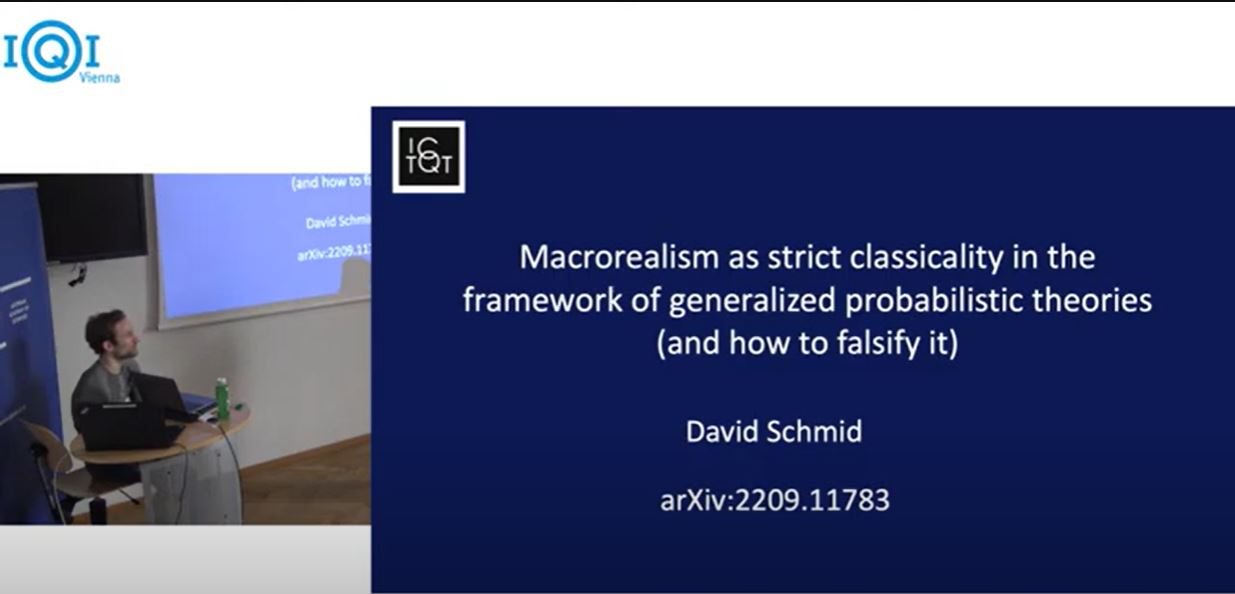
In this work, I critically analyze both the definition of macrorealism and the various proposed tests thereof, identifying a number of problems with these (and revisiting key criticisms raised by other authors). I then show that all these problems can be resolved by reformulating macrorealism within the framework of generalized probabilistic theories. In particular, I argue that a theory should be considered to be macrorealist if and only if it describes every macroscopic system by a strictly classical (i.e., simplicial) generalized probabilistic theory. This approach brings significant clarity and precision to our understanding of macrorealism, and provides us with a host of new tools—both conceptual and technical—for studying macrorealism. I leverage this approach i) to clarify in what sense macrorealism is a notion of classicality, ii) to propose a new test of macrorealism that is maximally informative and theory-independent (unlike all prior tests of macrorealism), and iii) to show that every proof of generalized contextuality on a macroscopic system implies the failure of macrorealism.
Information
Speaker: David Schmid (International Centre for Theory of Quantum Technologies, University of Gdansk)
Macrorealism as strict classicality in the framework of generalized probabilistic theories (and how to falsify it)
In this work, I critically analyze both the definition of macrorealism and the various proposed tests thereof, identifying a number of problems with these (and revisiting key criticisms raised by other authors). I then show that all these problems can be resolved by reformulating macrorealism within the framework of generalized probabilistic theories. In particular, I argue that a theory should be considered to be macrorealist if and only if it describes every macroscopic system by a strictly classical (i.e., simplicial) generalized probabilistic theory. This approach brings significant clarity and precision to our understanding of macrorealism, and provides us with a host of new tools—both conceptual and technical—for studying macrorealism. I leverage this approach i) to clarify in what sense macrorealism is a notion of classicality, ii) to propose a new test of macrorealism that is maximally informative and theory-independent (unlike all prior tests of macrorealism), and iii) to show that every proof of generalized contextuality on a macroscopic system implies the failure of macrorealism.
Information
Speaker: David Schmid (International Centre for Theory of Quantum Technologies, University of Gdansk)