



Indefinite causal order and the operational definition of events in perspective
In contrast, in general relativity, and even in few theories of quantum gravity, an event is defined as a point on a manifold. These two definitions oppose each other in specific examples, raising discussions on what can be considered a genuine task with indefinite causal order, and what should be considered just a simulation.
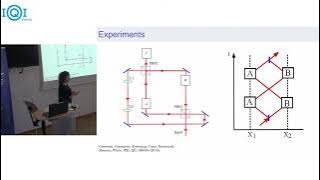
In this talk, I will discuss not just these two definitions of event, but a few others that appear in the literature. This discussion will be based on the review of some different realizations and proposals of the most famous task with indefinite causal order: the quantum switch. Firstly, I will discuss the optical experiments of quantum switch, and also one proposal of a gravitational quantum switch. Secondly, I will show intermediate situations, which are contributions of mine, in which the agents used to perform a quantum switch are in an entangled state of different accelerations, or lie on a curved spacetime in an entangled state of different heights. Regardless of the definition of event, we show that the latter case can be used as a test on the interplay of quantum physics and general relativity using the gravity of Earth, and this proposal is expected to be realized with current technology. Finally, I will summarize all different definitions of event and how each one is related to the interpretation of each scenario of quantum switch.
Information
Speaker: Natália Móller (Research Center for Quantum Information, Slovak Academy of Science)
Indefinite causal order and the operational definition of events in perspective
In contrast, in general relativity, and even in few theories of quantum gravity, an event is defined as a point on a manifold. These two definitions oppose each other in specific examples, raising discussions on what can be considered a genuine task with indefinite causal order, and what should be considered just a simulation.
In this talk, I will discuss not just these two definitions of event, but a few others that appear in the literature. This discussion will be based on the review of some different realizations and proposals of the most famous task with indefinite causal order: the quantum switch. Firstly, I will discuss the optical experiments of quantum switch, and also one proposal of a gravitational quantum switch. Secondly, I will show intermediate situations, which are contributions of mine, in which the agents used to perform a quantum switch are in an entangled state of different accelerations, or lie on a curved spacetime in an entangled state of different heights. Regardless of the definition of event, we show that the latter case can be used as a test on the interplay of quantum physics and general relativity using the gravity of Earth, and this proposal is expected to be realized with current technology. Finally, I will summarize all different definitions of event and how each one is related to the interpretation of each scenario of quantum switch.
Information
Speaker: Natália Móller (Research Center for Quantum Information, Slovak Academy of Science)