


A quantum limit to the speed of thermalization
24.09.2026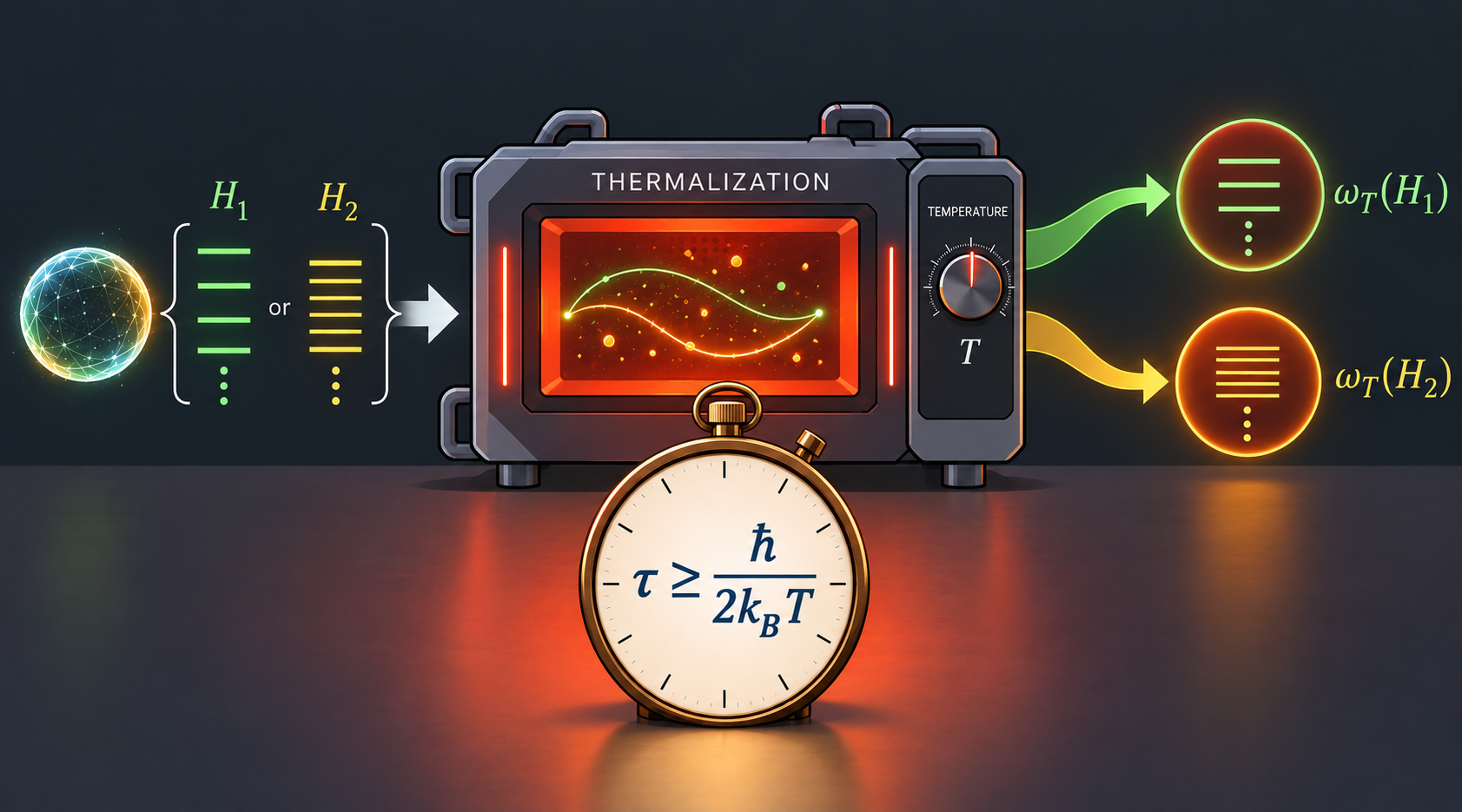
Thermalization—the process by which a physical system approaches thermal equilibrium—is ubiquitous in nature, from individual quantum systems to complex many-body materials. But how quickly can a system actually thermalize? A team of researchers has now established a fundamental lower bound on this timescale using only the basic principles of quantum mechanics and information theory.
In a collaboration between the Institute for Quantum Optics and Quantum Information (IQOQI) Vienna of the Austrian Academy of Sciences, together with colleagues from TU Wien, the Universitat Autònoma de Barcelona (UAB) and the University of Geneva, researchers have shown that quantum mechanics places a universal constraint on how quickly a system can be brought to thermal equilibrium. At finite temperature, the minimum timescale is set by one half of the Planckian dissipation time
$\tau_{\mathrm{Pl}} = \frac{\hbar}{k_{\mathrm{B}} T}$,
for sufficiently mixed thermal states. At very low temperatures, where a system approaches its ground state, the relevant bound instead becomes $\tau \gtrsim \frac{\hbar}{\Delta}$, where $\Delta$ is the energy gap between the ground and first excited states.
A long-standing question about the speed of thermalization
The timescale $\frac{\hbar}{k_{\mathrm{B}} T}$ has appeared in a variety of quantum many-body phenomena and was first coined by Jan Zaanen as “Planck scale of dissipation” in Nature 430, no. 6999 (2004), when observing an apparent universality in the resistivity of superconductors above their critical temperature. After that, it appeared in several condensed matter models, and it has been linked to the rate of growth of chaos in many-body systems (Maldacena et al. Journal of High Energy Physics, 2016(8)). In time, researchers started believing that $\tau_{\mathrm{Pl}}$ might represent a fundamental minimum timescale for thermalization and dissipation. Yet demonstrating such a bound in complete generality is difficult. In particular, if the energy structure – the so called Hamiltonian – of a system is already known, specially engineered interactions can prepare a particular thermal state extremely rapidly. This means that simply asking how quickly one can prepare one known thermal state is not enough to establish a universal limit.
The researchers take a different approach. They introduce a hypothetical “thermalization machine”: an arbitrarily powerful device whose only fundamental restrictions are that its evolution must obey quantum mechanics and that it must genuinely thermalize the system rather than merely prepare one predetermined state. In particular, the machine has to work for a nontrivial range of possible Hamiltonians (say, at least two), producing states close to the corresponding thermal equilibrium states.
From quantum information to a universal bound
The key insight is to view thermalization as an information-processing problem. “The key idea came from a rather unexpected field: quantum metrology” says Martí Perarnau-Llobet, working at UAB. If the Hamiltonian of the system is changed, the desired thermal state changes as well. The machine must therefore be able to respond differently to different Hamiltonians within the same amount of time. Quantum mechanics limits how distinguishable the resulting states can become within a given time. By combining this dynamical limitation with the distinguishability of thermal states, the researchers derive a general lower bound on the operation time of any thermalization machine. The argument uses concepts from quantum information geometry and quantum metrology.
The result is not merely a loose restriction that is far from what quantum mechanics permits. The authors construct a specially engineered thermalization machine that saturates the general bound for a pair of Hamiltonians.
At very low temperatures, the thermal state becomes increasingly concentrated in the ground state and the Planckian bound gives way to a different timescale governed by the energy gap. The resulting $\frac{\hbar}{\Delta}$ bound is closely connected to the familiar quantum adiabatic theorem.
A fundamental limit emerging from quantum mechanics
The result provides a structural reason for why the Planckian timescale repeatedly appears in dissipative quantum systems without being surpassed. Rather than deriving the timescale from a particular model of transport or thermal relaxation, the authors show that it can emerge directly from the combination of quantum dynamics and the information contained in thermal states.
“The striking point is that we don’t have to assume anything about the bath or the microscopic mechanism.” says Paolo Abiuso from IQOQI – Vienna, “In fact, even a quantum computer or any highly engineered machine respecting quantum mechanics cannot make a physical system thermalize faster. Formulating thermalization as an information-theoretic task is what allows us to generate a proof that is fully model-independent”.
The study opens several questions for future research, including how the bound behaves in large multipartite systems, what role entanglement plays in approaching the limit, and how closely realistic thermalization mechanisms can approach such fundamental bound.
Contact: Paolo Abiuso, paolo.abiuso(at)oeaw.ac.at