


Quantum diamond experiments: Towards testing whether gravity can entangle things
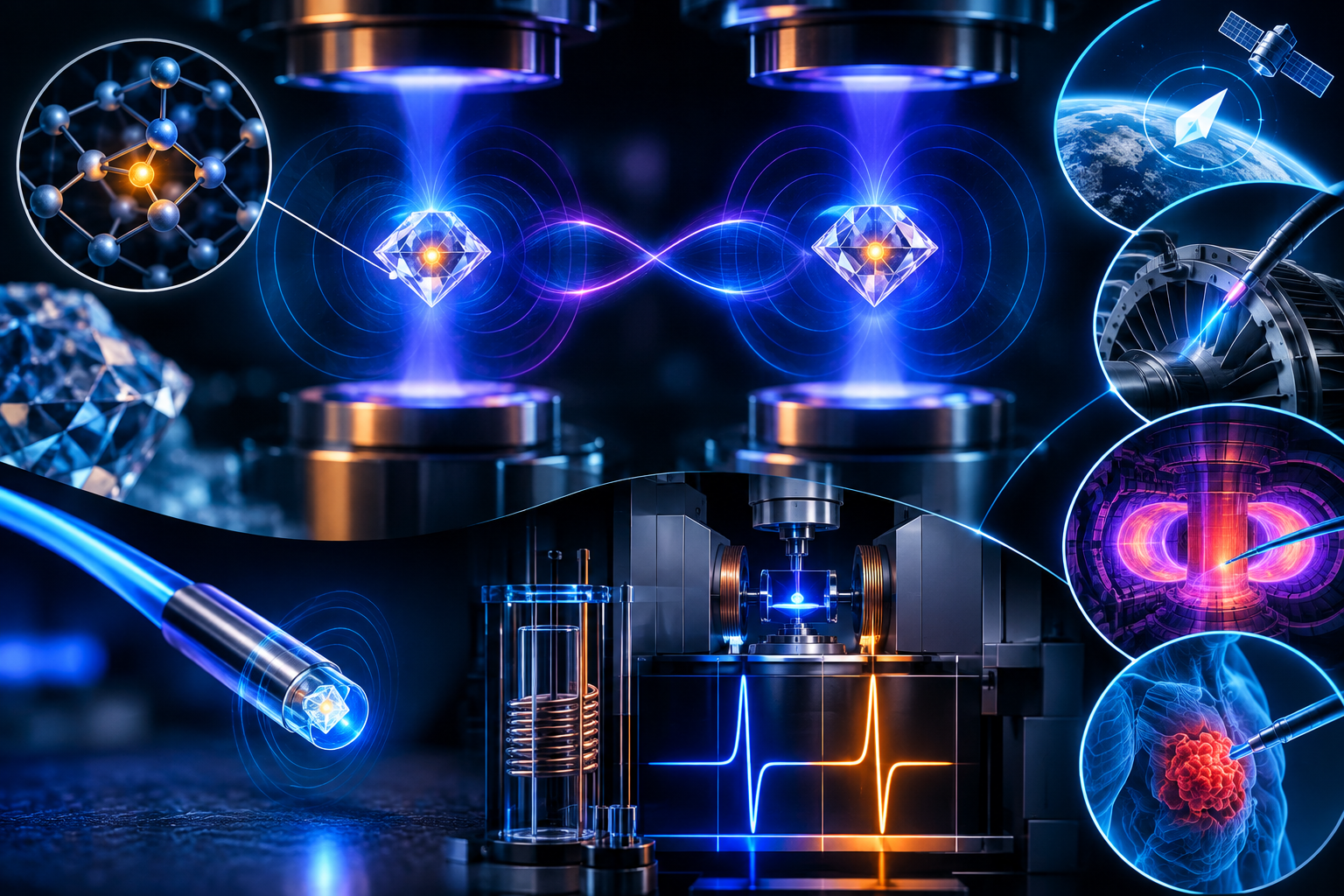
In my lab we have two such uses: the first is that we magnetically levitate one-micron-sized diamonds in vacuum because we want to get them into a quantum superposition of being in two places at once. We are designing an experiment that would use this to test if gravity is quantum by finding out if it can entangle things [1-5]. For this we have made nanodiamonds with the longest spin coherence times [6, 7].
The other diamond technology we build is sensitive diamond magnetometers that have a sensor head on the end of an optical fibre [8]. We want to use these for real-world applications such as navigation [9], non-destructive testing [10], tokamak diagnostics [11], and finding where cancer has spread to by looking for magnetic tracer fluids with an endoscopic probe [12].
All of these experiments could be helped by the experiment we built combining liquid-state NMR with high-field electron paramagnetic resonance (EPR), because this allows the most accurate and precise measurements of EPR g-factors [13].
[1] S. Bose et al., arXiv:2509.01586 (2025).
[2] B. D. Wood, S. Bose and G. W. Morley, Physical Review A 105, 012824 (2022).
[3] S. Bose et al., Physical Review Letters 119, 240401 (2017).
[4] C. Wan et al., Physical Review Letters 117, 143003 (2016).
[5] M. Scala et al., Physical Review Letters 111, 180403 (2013).
[6] J. E. March et al., Physical Review Applied 20, 044045 (2023).
[7] B. D. Wood et al., Physical Review B 105, 205401 (2022).
[8] S. M. Graham et al., Physical Review Applied 19, 044042 (2023).
[9] S. M. Graham et al., Diamond and Related Materials 152, 111945 (2025).
[10] A. J. Newman et al., Physical Review Applied 21, 014003 (2024).
[11] S. M. Graham et al., arXiv:2601.13413 (2026).
[12] A. J. Newman et al., Physical Review Applied 24, 024029 (2025).
[13] C. J. Stephen et al., arXiv:2601.14321 (2026).