• IQOQI Vienna
    • IQOQI Vienna Search
    • Institute
    • News & Events
    • People
    • Publications
    • Research
    • Units
  • Logo Logo
  • Institute for Quantum Optics and Quantum Information ViennaInstitute for Quantum Optics and Quantum Information Vienna
    Institute for Quantum Optics
    and Quantum Information
    Vienna
  • IQOQI Innsbruck ↗
  • IQOQI Wiki ↗
  • Blogs
  • DE
  • EN
Open search bar
Open Main navigation
  • Institute
    • Mission Statement
    • History
    • Scientific Advisory Board
    • Funding
    • Jobs
    • Partners
  • News & Events
    • News
    • (Online) Events
    • Calendar
    • Ehrenfest Award
  • People
  • Publications
  • Research
    • Aspelmeyer Group
    • Asenbaum Group
    • Brukner Group
    • Castro Ruiz Group
    • Christodoulou Group
    • Huber Group
    • Müller Group
    • Navascués Group
    • Zeilinger Group
    • Topical Teams
  • Units
    • Quantum Technology Unit
    • IQOQI Innsbruck ↗
    • IQOQI Wiki ↗
    • Blogs
    • DE
    • EN
Open search bar
  • IQOQI Vienna
    • IQOQI Vienna Search
    • Institute
    • News & Events
    • People
    • Publications
    • Research
    • Units

IQOQI Vienna Search

  • Share via email
  • Share on LinkedIn
  • Share on Facebook
  • Share on Bluesky

Filter

The search via the website www.oeaw.ac.at is a faceted search:
In the first input field you can enter a search term and use the filters (facets) below to limit the result.

Make a selection under the Person facet in order to find specific members or employees. With the page type facet you can select "Events" for a search for OeAW events, "News" for news from the OeAW and "Pages" for fixed pages within the OeAW website.

Searched for computer.
Displaying results 11 to 20 of 770.
  • News
    Computational Advantage from Quantum-Controlled Ordering of Gates
    07.01.2015
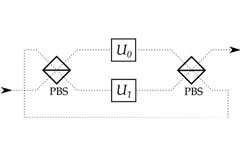
    Quantum computation procedures are usually performed by applying gates in a fixed order. In the new publication "Computational Advantage from Quantum-Controlled Ordering of Gates" in Physical Review Letters, CoQuS student Mateus Araújo, CoQuS alumnus Fabio Costa and Časlav Brukner show that superimposing the order of gates might provide quantum computers with an additional computational advantage. Original Publication: Computational Advantage from Quantum-Controlled Ordering ...
  • News
    Error protected quantum bits entangled
    14.01.2021
    Even computers can miscalculate. Already small disturbances change stored information and corrupt results. That is why computers use methods to continuously correct such errors. In quantum computers, the vulnerability to errors can be reduced by storing quantum information in more than a single quantum particle. These logical quantum bits are less sensitive to errors. In recent years, theorists have developed many different error correction codes and optimized them for ...
  • News
    MICIUS PRIZE PRESENTED TO BLATT, ZEILINGER AND ZOLLER
    19.09.2019
    prizes were presented in the Chinese city of Hefei as part of the International Conference on Emerging Quantum Technology. Rainer Blatt received a Micius Prize for his pioneering experiments on quantum computers, and Peter Zoller, together with Juan Ignacio Cirac, for theoretical work on quantum computers. Anton Zeilinger and his former graduate student Jian-Wei Pan were recognized for their groundbreaking experiments on secure quantum communication over long distances. Five ...
  • News
    QuantumGain
    26.03.2024
    " QuantumGain - An Austrian deep tech, hidden champion for superconducting quantum computer hardware" is led by Philip Schmidt , a postdoctoral researcher in the research group of Markus Aspelmeyer at IQOQI Vienna, and will start in April. It is the only funded project from the last call that takes place at a non-university research institution, the Austrian Academy of Sciences. “Quantum computers, with their quantumbits, can be envisioned as a big orchestra. The quantumbits ...
  • News
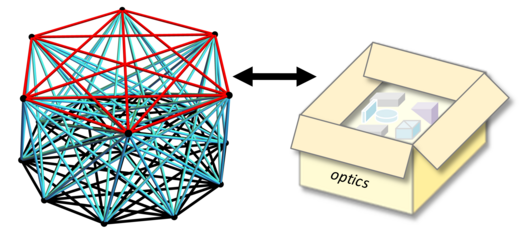
    Hidden bridge between graph theory and quantum experiments uncovered
    08.03.2019
    colleagues to discover a novel, unexplored type of quantum interference which happens when many photons are involved. This quantum interference is the basis of a new special-purpose scheme of quantum computation, which can be exploited to solve Graph Theory questions that are intractable on a classical computer. This new connection between these seemingly unrelated fields also revealed new insights into quantum state generation with current photonic technology. In general, ...
  • News
    Quantum revolution takes a leap forward
    24.01.2020
    they were looking to manipulate. By cleverly shaping the spatial structure of the photon by means of carefully designed computer-generated holograms, they were able to achieve high quality transformations while maintaining maximal flexibility and versatility. “We hope that this experiment might trigger new pathways in the field of optical quantum communication and computation”, explains Assistant Professor (tenure track) Robert Fickler , group leader at Tampere University. ...
  • News
    Best-Thesis Award for Ämin Baumeler and Daniel Gruss
    01.10.2018
    Loops: Logically consistent correlations, time travel, and computation“. The thesis was conducted under the the supervision of Prof. Stefan Wolf at the Faculty of Informatics, Università della Svizzera italiana (USI), Lugano, Switzerland. In his work, Ämin Baumeler continues the works initialized by Fabio Costa, Ognyan Oreshkov and Časlav Brukner on non-causal correlations. That work was thereby extend to computer science, computability and time travel. The Thesis The Award ...
  • News
    Invitation to a talk by Jan-Ake Larsson on Wednesday, December 6th 2017, 15:00h
    06.12.2017
    A long-standing aim of quantum information research is to understand what gives quantum computers their advantage. Such an understanding would be of great benefit when attempting to build a quantum computer. Here we present a framework that uses classical resources but still is able to efficiently run, for example Deutsch-Jozsa and Simon's algorithms, and also can run Shor's factoring algorithm with some systematic errors. We also perform an experiment factoring 15 using ...
  • News
    Invitation to a talk: Andrew Garner
    12.09.2017
    Simulating the stochastic evolution of real quantities on a digital computer requires a trade-off between the precision to which these quantities are approximated, and the memory required to store them. The statistical accuracy of the simulation is thus generally limited by the internal memory available to the simulator. In this presentation, using tools from computational mechanics, I shall show that quantum information processing allows the simulation of stochastic ...
  • News
    Invitation to a talk: Gavin Brennen, Wednesday Feb. 21th 2018, 3:00 pm at the IQOQI Seminar Room
    21.02.2018
    market capitalization of several hundred billion US dollars, and while they are extremely volatile, some number of them are likely here to stay. With the development of quantum technology it is natural to ask how secure is Bitcoin to future quantum computer attacks. I'll introduce the basics of a Bitcoin transaction and describe the threat of quantum attacks on Proof of Work based mining and to digital signatures, as well as how to defend against them. Joint work with Divesh ...
  • 1
  • 2
  • 3
  • 4
  • 5
  • 6
  • 7
  • 8
  • 9
  • 10
  • ....

Contact

Institute for Quantum Optics and
Quantum Information - Vienna
of the Austrian Academy of Sciences

Boltzmanngasse 3
1090 Vienna, Austria

Phone +43 1 51581-9500
iqoqi-vienna(at)oeaw.ac.at

IQOQI Vienna

We pursue the vision of quantum information science and the wide range of new possibilities it would open up for quantum technologies.

Newsletter

Subscribe to our newsletter to stay informed on new IQOQI research findings.

Subscribe


  • ÖAW onFacebook
  • ÖAW onInstagram
  • ÖAW onBluesky
  • ÖAW onYoutube
  • ÖAW onLinkedIn
  • ÖAW onSpotify

Imprint Data Protection Accessibility

© Copyright OEAW

Notice about cookies

This site uses cookies. They ensure essential functionalities of the website and enable us to continuously optimize content. Help us by agreeing to the collection of statistical data and the presentation of external multimedia content. You can change your cookie settings at any time. Further information can be found in the privacy settings and by clicking the Data Protection Link.

These cookies are required for the smooth functioning of our website.

Name Purpose Storage duration Type Provider
CookieConsent Remembers your consent to the use of cookies. 1 year HTML Web Consent
fe_typo_user Assigns your browser to a session on the server. This only affects the content you see and is not evaluated or processed by us - HTTP Web User

With the help of these cookies, we strive to make our offer even more attractive for you. The user flow can be analyzed and assessed using pseudonymised data from website users. This gives us the opportunity to optimize website content.

Name Purpose Storage duration Type Provider
_pk_id Used to store a few details about the user like unique visitor ID. 13 months HTML Matomo-id
_pk_ref Used to store information about the user's referring website. 6 months HTML Matomo-ref
_pk_ses Short-term cookie to save temporary data from the visit. 30 minutes HTML Matomo-ses
_pk_cvar Short-term cookie to save temporary data from the visit. 30 minutes HTML Matomo-cvar
_pk_hsr Short lived cookie used to temporarily store data for the visit. 30 minutes HTML Matomo

With the help of these cookies, we strive to improve the information we offer users by providing multimedia or interactive content such as videos.

Name Purpose Storage duration Type Provider
YouTube A connection to YouTube will be established to view videos. - Connection YouTube
SoundCloud A connection to SoundCloud will be established to play audio files. - Connection SoundCloud
Twitter A connection to Twitter will be established to display tweets. - missing translation: type. Twitter
_cs_c Indicates whether the user has consented to ContentSquare tracking. 394 days missing translation: type. Spotify (ContentSquare)
_cs_id Stores a unique user ID for ContentSquare session analysis. 394 days missing translation: type. Spotify (ContentSquare)
_ga Used to distinguish users. 400 days missing translation: type. Google Analytics
_ga_BMC5VGR8YS Used by Google Analytics to persist session state. 400 days missing translation: type. Google Analytics
_ga_S0T2DJJFZM Used by Google Analytics to persist session state. 399 days missing translation: type. Google Analytics
_ga_ZWG1NSHWD8 Used by Google Analytics to persist session state. 400 days missing translation: type. Google Analytics
_ga_ZWRF3NLZJZ Used by Google Analytics to persist session state. 400 days missing translation: type. Google Analytics
_gid Used to distinguish users. 1 days missing translation: type. Google Analytics
_ScCbts Stores temporary session or playback preferences. 6 days missing translation: type. Spotify
_scid Spotify advertising ID used for analytics and retargeting. 395 days missing translation: type. Spotify
_scid_r Spotify advertising ID used for analytics and retargeting. 395 days missing translation: type. Spotify
eupubconsent-v2 Stores the IAB Transparency & Consent Framework string. 364 days missing translation: type. IAB / Spotify
OptanonAlertBoxClosed Saves the state of your data protection consent. 364 days missing translation: type. OneTrust
OptanonConsent Saves the state of your data protection consent. 365 days missing translation: type. OneTrust
sp_adid Spotify advertising identifier. 365 days missing translation: type. Spotify
sp_landing Tracks which page the user landed on within Spotify. 1 days missing translation: type. Spotify
sp_m Stores the user’s market region (Spotify). 399 days missing translation: type. Spotify
sp_t Session token used for Spotify playback and access. 365 days missing translation: type. Spotify