



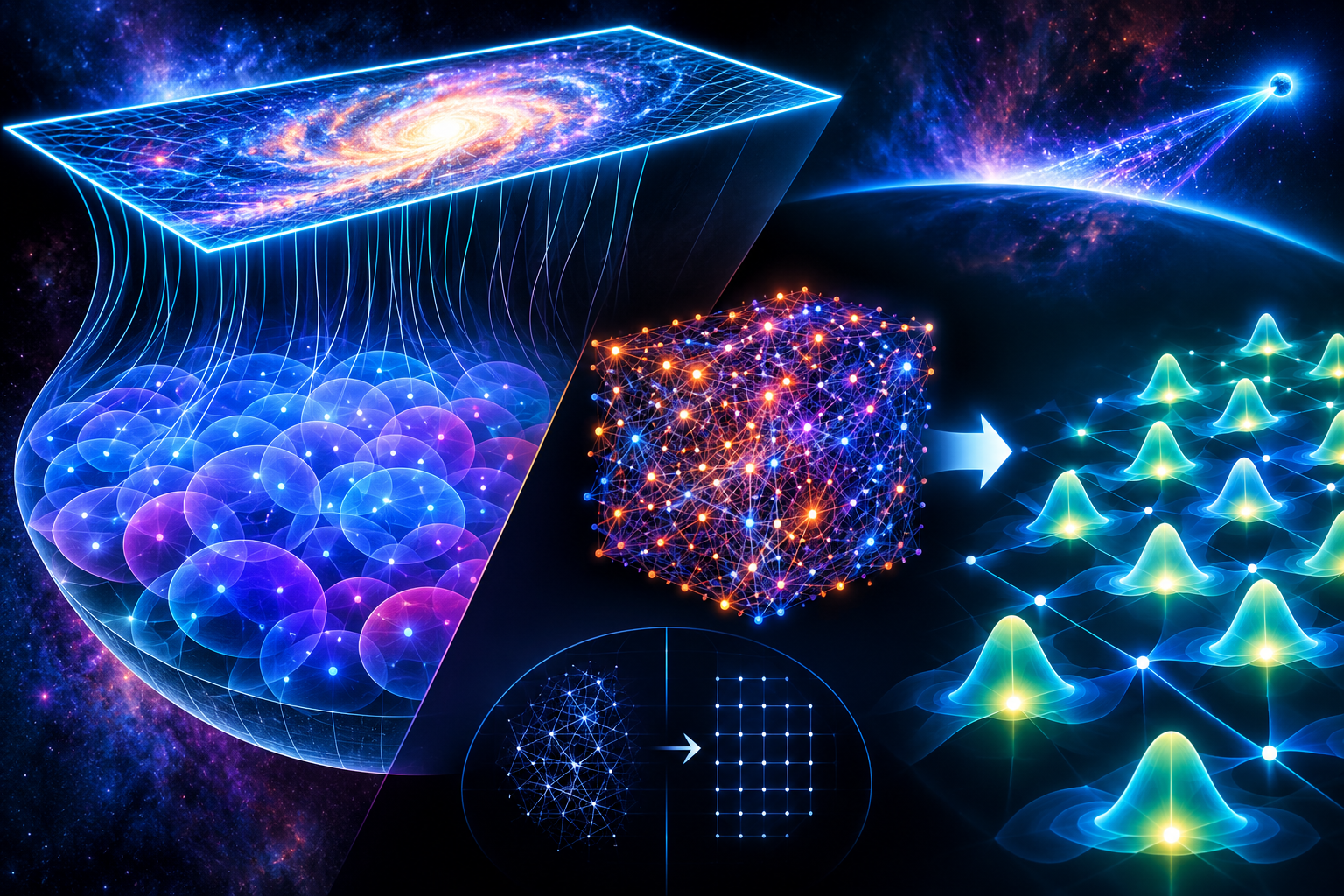
In quantum gravity, where no background spacetime is available to supply it, that structure may be expected to emerge from the theory itself. In this talk I take this question of “quantum mereology” seriously and follow it towards the holographic principle. I will first describe a simple model of holography in which a fermionic field is built out of slightly overlapping modes, packing far fewer independent degrees of freedom into the Hilbert space than conventional field theory would. The resulting theory satisfies a cosmic Bekenstein bound and predicts a finite lifetime of plane waves (for example, of high-energy cosmic neutrinos). From the point of view of mereology, the same model, written in terms of independent degrees of freedom, looks like a random, highly non-local Hamiltonian. This suggests that a fairly generic quantum system can appear as a nearly free, local field theory once described in the right variables. In the second part of the talk, I will ask how to find such variables starting from the Hamiltonian alone. I will show how a suitable choice of Fock basis can make a non-local random matrix model look like a local lattice theory where particles propagate as wave packets. Together, these results suggest that locality, and the number of local degrees of freedom, can emerge from the structure of the Hamiltonian rather than being assumed from the start. Based on joint work with C. Cao, S. Carroll, G. Cheng, O. Friedrich, M. Girard and N. Loizeau.
Information
Speaker:Ashmeet Singh (Indian Institute of Technology Delhi)
Time:11:00
Follow the talk here