



A spacetime-covariant framework for inertial and accelerated quantum clocks in first quantization: unitarity and quantum time dilation in the positive mass sector
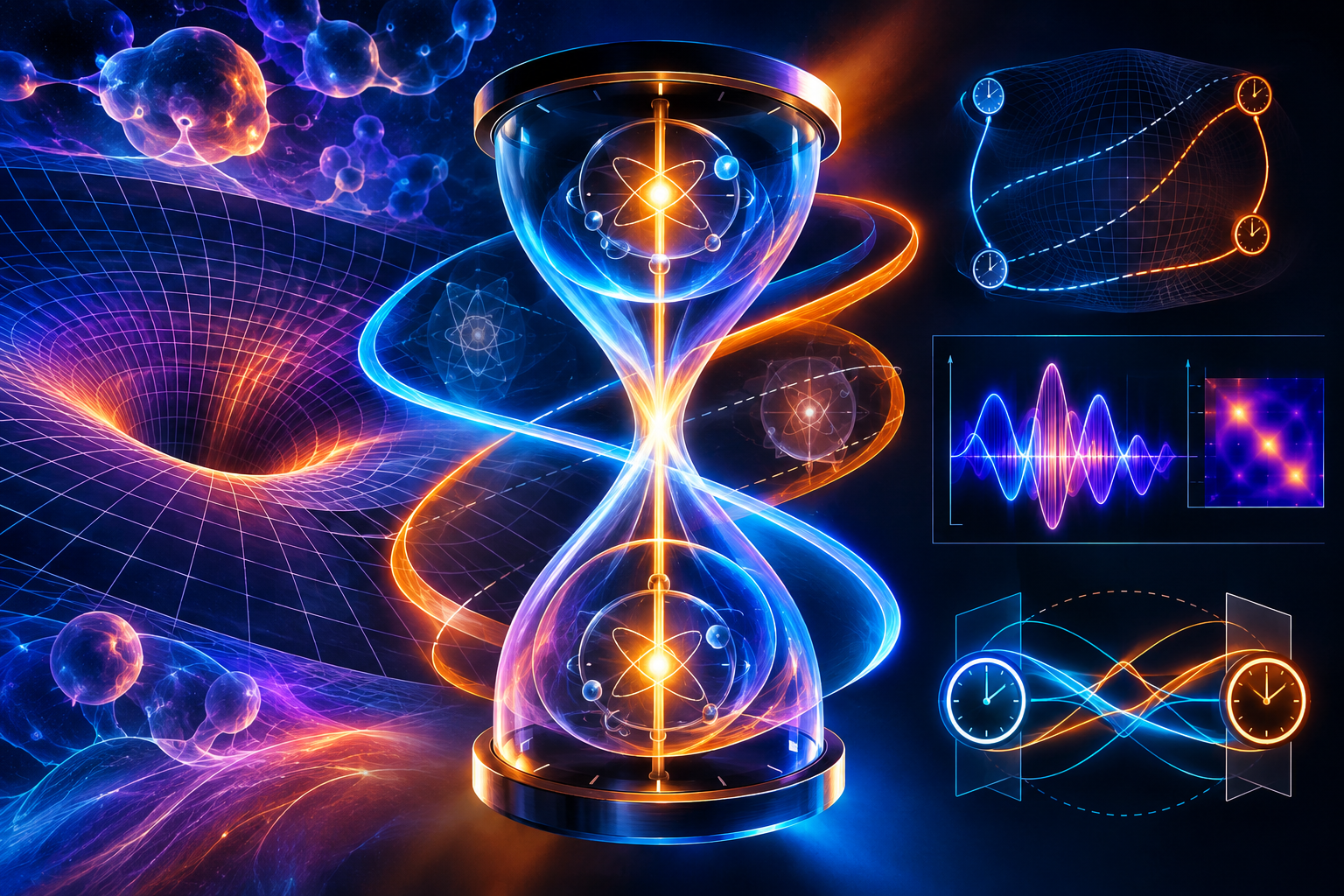
Quantum Clocks, i.e. quantum mechanical systems whose internal dynamics keep track of proper-time lapses, are a promising tool for probing such superpositions. In this talk, we present a spacetime-covariant approach to describe these clocks in first quantization, accounting for the possibility of dynamically accelerated clocks via suitable local couplings with external fields. We show that a particular decomposition of the (quadratic) clock Hamiltonians into positive and negative mass sectors, when attainable, enables one to compute the evolution of the system directly in terms of a reference clock's proper-time while maintaining explicit covariance. When this decomposition is possible, the evolution thus obtained is always unitary. We apply this formulation to compute the joint time evolution of pairs of inertial and (circularly) accelerated quantum clocks. In both cases, when our clocks follow quasiclassical histories, or "worldfunctions", we find a conditional time dilation observable whose probabilities peak exactly at the classical expected value. However, when they are prepared in coherent superpositions of such worldfunctions, we find a quantum-coherent time dilation profile which both displays proper-time interference and yields distinctively off-diagonal coherences, allowing e.g. the realization of operations in indefinite causal order.
Information
Speaker: Eduardo Barbosa Oliveira (Sao Paulo State University)
Time: 14:00